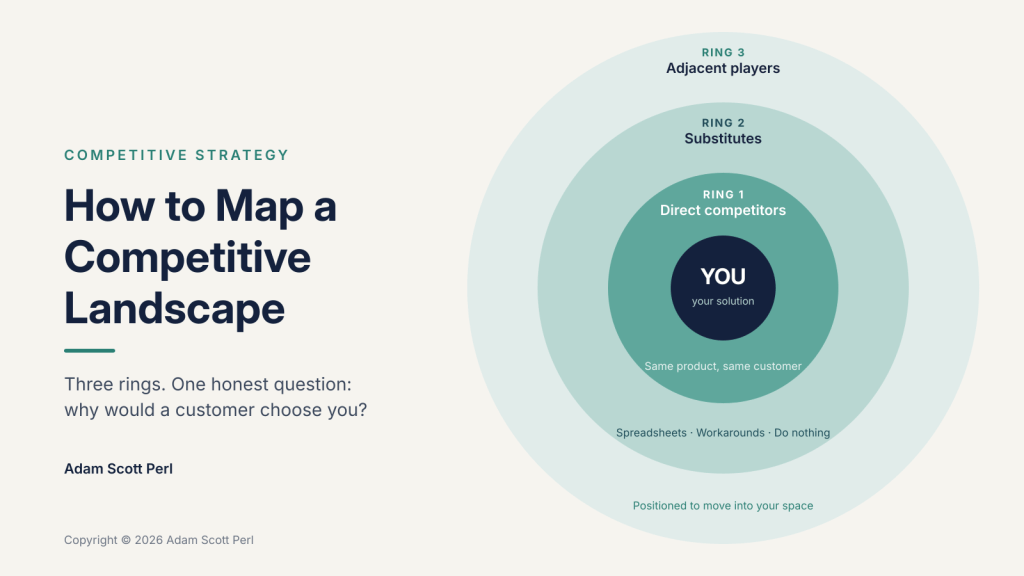
First, what is a competitive landscape map?
It’s a picture of every option your customer has for solving their problem, including the options that aren’t companies at all. Building one forces you to answer the question every founder and investor cares about: why would anyone choose you instead?
The map has three layers, which I call rings. Your solution sits in the middle. The closer a ring is to the center, the more directly it competes with you.
To make this concrete, we’ll use one example throughout. Say you’re launching an app that helps small restaurants schedule staff shifts.
Map all three rings
Most people list the three or four companies that show up first in a Google search and call it done. That’s only the inner ring. It misses most of what matters.
Ring 1: Direct competitors
What it is: companies selling the same (or a very similar) product to the same customer. These are the names customers mention when you ask who else they considered.
In our example: other shift-scheduling apps built for restaurants.
Gut check: if you can’t find at least two or three, either your market is genuinely new (rare) or you haven’t looked hard enough (likely).
Ring 2: Substitutes
What it is: anything else your customer uses to solve the same problem today, before your product exists. A spreadsheet, a workaround, a hired service, a manual process.
In our example: a paper schedule taped to the break-room wall, a group text, or the manager’s Excel file.
Why it matters: this is where almost everyone undercounts. It’s often your biggest competition, because it’s the habit you actually have to replace.
Ring 3: Adjacent players
What it is: companies that don’t solve your problem today but could start tomorrow. A well-funded neighbor that pivots, or a big incumbent that adds a feature.
In our example: payroll or point-of-sale software that decides to bolt on scheduling.
How much to worry: don’t obsess, but keep an eye on them. One feature launch can redraw your map overnight.
Don’t forget “do nothing”
Doing nothing is a real option, and it belongs on the map. In our example, plenty of managers just text people when someone calls in sick and live with the chaos.
If “do nothing” is what most customers do today, that tells you something important. The problem may not hurt enough yet, and you’ll have to work harder to get people to switch.
Know each direct competitor cold
For every Ring 1 player, find out:
- What they offer: the core product, and who they claim to serve.
- How they price: or the signals, if it isn’t public. Free tier? Self-serve? Enterprise-only?
- How they position: the language on their homepage. What job do they claim to do?
- What customers say: G2, Capterra, Trustpilot, App Store reviews, Reddit. The complaints are often your opening.
- What they’re not doing: the segment they’ve declined to serve, the gap in their feature set.
In our example: you might read app-store reviews of the other scheduling apps and find that restaurant managers keep complaining their staff won’t download yet another app. That complaint is an opening.
Good free sources: websites and pricing pages, review sites, Reddit communities where your customer hangs out, SEC filings, and job postings. A company hiring hard in one area is showing you its roadmap.
One caution. Asking an AI “who competes with X?” is a fine way to generate leads and a terrible way to build the map. It will confidently name companies that don’t exist, describe discontinued products, and miss the Ring 2 substitutes that matter most. Verify everything on the company’s actual website.
Answer the differentiation question
Once the map is done, answer one question honestly: why would a customer choose you?
“We’re better” doesn’t count. Better at what, for whom, and why can’t they just copy it? There are only a handful of defensible answers:
- You serve a group the big players ignore. Your product isn’t for everyone. It’s for a specific group that’s underserved, overcharged, or simply overlooked. This is the easiest path for a young company. Example: built only for restaurants with fewer than 15 staff, which bigger tools treat as too small to bother with.
- You solve the problem in a fundamentally different way. Not a better version of what exists, but a different approach that makes the competitors’ strengths irrelevant. Harder to pull off, but much harder to copy. Example: staff swap shifts by replying to a text message, so nobody downloads anything.
- You can reach customers others can’t. You have a sales or distribution channel the incumbents don’t, or you reach people at a cost they can’t match. Chronically underrated. Example: a partnership with a state restaurant association that recommends you to its members.
- Your timing is better. A new technology, regulation, or habit makes this moment different from three years ago. The incumbents built for the old world; you’re building for the new one. Example: new “fair workweek” rules in some cities require restaurants to post schedules in advance.
Be honest about the weaker claims. “We’re cheaper” is a strategy, but a fragile one unless you have a structural cost advantage a well-funded competitor can’t replicate. “We have better design” is a positioning claim, not a moat.
The goal is differentiation that’s real and durable. Or the honest admission that you’re entering a crowded space and will have to earn your position one customer at a time.
Your map, in five steps
- List your direct competitors (Ring 1). Aim for at least two or three.
- List every substitute your customer uses today (Ring 2), including “do nothing.”
- Note the adjacent players who could move into your space (Ring 3).
- Research each direct competitor: offer, price, positioning, reviews, and gaps.
- Write one honest sentence on why a customer would choose you, and why no one can copy it tomorrow.


Leave a Reply