What Makes Something an Opportunity?
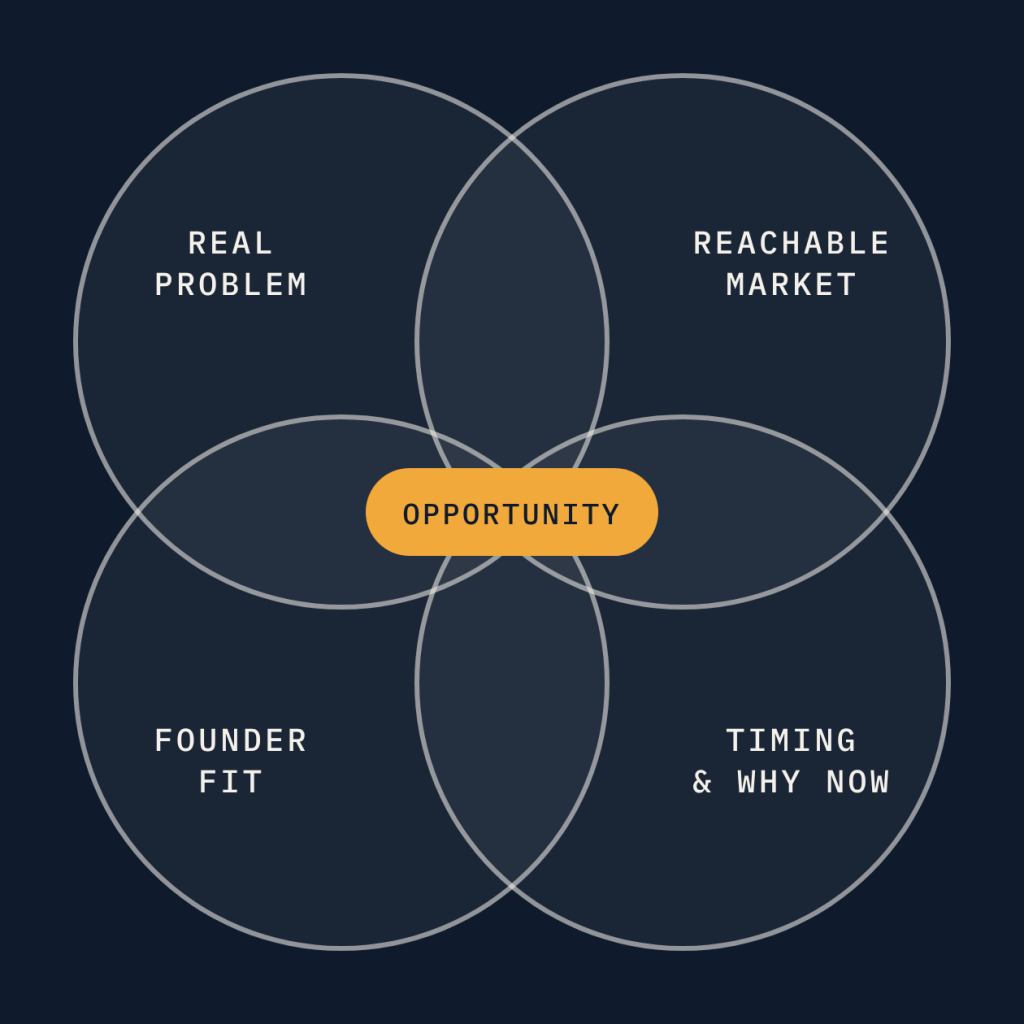
Entrepreneurship researchers and practitioners have wrestled with this for decades. Here’s the most useful synthesis: an opportunity exists at the intersection of four things.
1. A Real Problem (or Unmet Desire)
Not a hypothetical problem. Not a problem you assume exists. A problem that a specific, identifiable group of people actually experience — and experience in a way that causes them friction, cost, frustration, or loss.
- “People would love a better way to X” is a hypothesis. “I’ve talked to 20 people who all spend 4 hours a week doing X manually and hate it” is a signal.
- Pain intensity matters enormously. A mild inconvenience rarely supports a business. The stronger the pain, the more likely people are to pay to make it stop. The key question: Is there genuine pain here, or is this a nice-to-have? Are they willing to pay for the pain to go away?
2. A Market That Justifies the Effort
- Even a real problem needs to exist at a scale — or price point — that makes a business viable. A problem experienced by 50 people who’d pay $10 for a solution is not the same as a problem experienced by 50,000 people who’d pay $100.
- You don’t need a Goldman Sachs analyst report. You need a rough, defensible sense of how many potential customers exist and what they’d realistically pay.
- A common mistake is confusing a large total market with a reachable one. The global coffee market is enormous. That doesn’t mean a new coffee brand will capture a meaningful share without a specific, differentiated wedge.
3. Timing
“Why now?” is one of the most important questions any investor asks — and one most founders can’t answer. Markets and technologies create windows. the best ideas pursued at the wrong time fail, and the same ideas at the right time become category-defining companies.
Timing factors to look for: a technology that just became cheap or accessible;
- a regulatory shift that opened a market or closed a competitor; –
- a behavioral change that’s accelerating; an underserved customer whose needs are growing, not shrinking.
If you can’t articulate why the window for your idea is open now, that’s a flag.
4. Founder Fit
This one is underrated in academic settings but central to how real investors evaluate opportunities. The same opportunity in different hands produces wildly different outcomes.
- Founder fit means: do you have a credible reason to be the one to pursue this? That could be domain expertise (you worked in the industry, you live the problem), network access (you know the customers, the suppliers, the gatekeepers), technical skill (you can build the thing without hiring anyone), or unique insight (you see something about this market that others miss).
“I’m passionate about it” is not founder fit. Passion is table stakes. The question is whether you have structural advantages that make you more likely to succeed than someone equally passionate with no background here.
A Simple Initial Screening Framework
When you have an idea and want to quickly pressure-test it, run it through these five questions. This is not a full feasibility analysis — that comes in Module 2. This is a rapid filter.
Question 1: Who specifically has this problem?
Name the customer. Not “small businesses” — which type, which size, in which industry, at what stage? Not “people who travel” — business travelers vs. leisure vs. digital nomads are completely different customers with different needs and willingness to pay. If you can’t describe a specific person with this problem, you don’t have an opportunity yet. You have a category.
Question 2: How do they solve it today?
Every problem has a current solution, even if that solution is “people just live with it” or “they hire someone.” Understanding the existing alternatives is essential because it tells you what customers are already paying (price anchor), shows you what “good enough” looks like in their minds, and reveals the switching cost — what you’d need to be better by how much to get them to change behavior. No alternatives usually means no market. Lots of bad alternatives usually means opportunity.
Question 3: Why hasn’t this been solved well already?
If the problem is real and the market is large, why doesn’t a good solution already exist? Possible legitimate answers: the enabling technology just arrived; regulation recently changed; the incumbent has no incentive to cannibalize themselves; the customer segment was too small to attract outside capital but is large enough for a focused business. “Nobody thought of it” is almost never the real answer.
Question 4: How big could this realistically get in 3 years?
Back-of-napkin math, not a spreadsheet model. If you capture 1% of your addressable market, what does that look like in revenue(TAM/SAM/SOM)? Is that a business worth building? Is it interesting enough to attract talent, capital, or partners?
Question 5: Why you, why now?
Combine founder fit and timing. Can you articulate a crisp answer to both?
Ideas That Look Good But Aren’t (Yet)
Recognizing false positives is as important as recognizing real opportunities. Watch for these common traps.
- The “friends agree” trap. If everyone in your friend group thinks it’s a great idea, that’s weak validation. Your friends are not objective evaluators — they want to support you. Talk to strangers who actually have the problem, and specifically to people who tell you no.
- The “I’d use it” trap. You are one data point. Sometimes a founder’s own experience is the best signal. But often the founder is not representative of the actual market. A 22-year-old business student building for 22-year-old business students needs to ask whether that market is big enough to matter.
- The “big market” trap. “Healthcare is a $4 trillion market” tells you almost nothing about whether your specific idea can capture any of it. Large markets attract large incumbents with large moats. Specificity beats scale in early-stage thinking.
- The “solution looking for a problem” trap. You learn a technology — AI, blockchain, whatever — and then go looking for something to apply it to. The technology may be real. The opportunity may not be. Start from problems, not tools.
Why Your Own Experience Is (Sometimes) Your Best Asset
Some of the most durable businesses were built by founders who lived the problem themselves. This is sometimes called the “scratch your own itch” model — you experience a genuine frustration, look for a solution, find nothing good, and decide to build it.
This approach has real advantages: you understand the customer viscerally, you know what “good” looks like, you have conviction that the problem is real. The risk is the “I’d use it” trap above — you have to honestly assess whether others share your problem, and at what scale.
If you are the target customer, your Idea Log entries should include a note about whether this is a personal pain point — and if so, whether you’ve tested whether others share it.


Leave a Reply