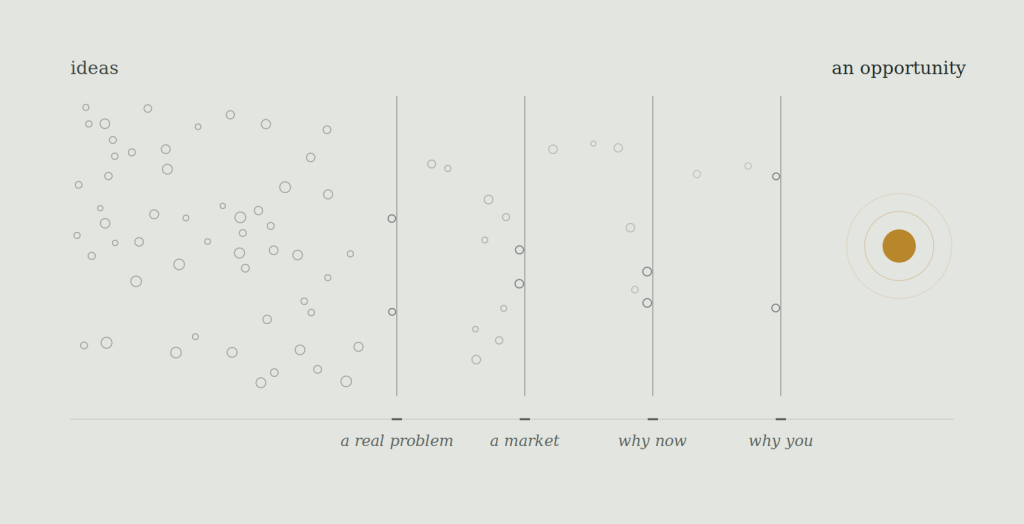
I’ve spent twenty years on one side or the other of this conversation. Founding companies. Advising them. Writing checks into them. And the most expensive mistakes I’ve watched, including my own, almost never trace back to a bad idea.
They trace back to a founder who never checked which one he was holding.
I now spend part of my week arguing about this in a classroom. As Adjunct Professor at the UConn School of Business, I teach Opportunity Generation, Assessment, and Promotion — a semester built around the distinction below. Teaching it has clarified something twenty years of doing it did not: the failure is almost never analytical. Founders can run the test. They just don’t run it on themselves.
Three words that aren’t synonyms
An idea is a notion. It costs nothing and obligates nothing. Everybody has them.
An innovation is an idea made real. Someone built it. That’s an achievement, and it is still not a business.
An opportunity is an idea with conditions attached — conditions that make it worth pursuing now, by you, for these customers. Remove any one of those and what you have is a project with a burn rate.
The gap between the second word and the third is where companies die. Not at the idea stage, where failure costs a weekend. Eighteen months and four hundred thousand dollars in, building something nobody asked for, with a team that believed you.
The four conditions
Run whatever you’re working on through these. Out loud, ideally in front of someone with no reason to be kind to you.
Is there a real problem? Not an inconvenience you can make sound urgent in a deck. A problem someone is already paying to work around — in money, in hours, or in workarounds they’ve stopped noticing they perform.
Does the market justify the effort? The question isn’t whether a market exists. It’s whether it’s large enough, reachable enough, and willing enough to pay back the years it’s about to take from you.
Why now? Something must have changed. A cost curve, a regulation, a behavior, a platform. If the answer is “nothing, people just haven’t done it yet,” the likelier explanation is that people have done it, repeatedly, and it didn’t work.
Why you? This is the one founders skip, because it’s the only condition that can disqualify them personally. What do you know, or have access to, that makes you a better bet on this problem than the next person with the same slide?
Most ideas fail this test. They don’t fail because they’re stupid. They fail because nobody checked before building.
Luck favors the already-looking
There’s a permanent argument about whether entrepreneurs generate opportunities systematically or stumble into them. The honest answer is both, and it’s the wrong question.
The better question is what makes someone more likely to stumble well.
The founders who “got lucky” are overwhelmingly the ones who were already looking. They had domain exposure. They’d noticed friction everyone around them had learned to tolerate. Paul Graham named one version of this — schlep blindness, our instinct to look away from problems that involve tedious, unglamorous work, which is exactly why those problems stay unsolved and stay valuable.
You can’t manufacture luck. You can manufacture prepared attention, and it produces something that looks identical from the outside.
The failure mode nobody designs around
Here’s what I’ve come to believe is the single hardest problem in early-stage judgment:
Founders are exceptional at validating assumptions they already hold, and terrible at stress-testing them. Conviction is the trait that gets you funded and the trait that gets you killed, and it’s the same trait.
You cannot fix this with more discipline. Discipline is precisely what conviction overrides.
The only counter I’ve found that reliably works is structural: pre-commitment. Before you start gathering evidence, write down what a No-Go looks like. Name the number, the churn rate, the conversion, the customer response that would make you stop. Do it while you’re still calm and the sunk costs haven’t started voting.
Then, when the evidence arrives, you’re not deciding. You’re reading something you already decided.
A related point about AI
The same discipline applies to how most of us now produce work.
AI has collapsed the cost of generating plausible material — market sizings, competitive analyses, customer personas, whole strategy memos. Velocity is up enormously. What hasn’t changed is that errors arrive interleaved with genuinely good output, and they arrive in the same confident register.
Which means the scarce skill is no longer production. It’s judgment: the ability to evaluate and refine what comes back.
My rule is simple. Every figure I put in front of an investor or a customer comes from a source I personally opened. Not because using the tools is a problem, but because a number that falls apart the moment someone asks about it is the most expensive thing in the room.
What I’d do this week
Write the four conditions on one page. Put your idea through them without flattering it.
Then write your No-Go, date it, and send it to someone who will hold you to it.
Most ideas won’t survive that. That’s the entire value of doing it. The ones that do are worth the next four years of your life.
 Adam Scott Perl
Leave a comment